DSCR vs Conventional
DSCR loan vs conventional: which fits the property you are buying.
A conventional loan qualifies you. A DSCR loan qualifies the property. That single difference drives everything else: documents, speed, vesting, and how far your portfolio can scale.
Direct private lender · 110 Wall Street, New York · Licensed in 48 states · NMLS #2832335 · Equal Housing Lender
The mechanics, side by side.
| Conventional | DSCR | |
|---|---|---|
| Qualifies on | Your income, tax returns, DTI | The property’s rent against its payment |
| Tax returns | Two years, plus W-2s or K-1s | Not required |
| Vesting | Personal name, generally | LLC or entity is standard |
| Property count | Caps out as you scale | Built for portfolios |
| Speed | Follows the retail mortgage process | Follows the deal |
| Use case | Primary homes, first rentals | Business-purpose investment property |
Business-purpose lending only. DSCR loans are for investment property, not primary residences.
What 1.20x actually means.
DSCR is the property’s monthly rent divided by its full monthly payment: principal, interest, taxes, insurance, and association dues. If the market rent is $2,400 and the full payment is $2,000, the DSCR is 1.20x. Illustration only, not a commitment to lend. A common pricing benchmark is 1.20x and above; some programs allow lower ratios with adjustments. Where your deal lands depends on the rent the appraisal supports, the taxes and insurance on the asset, and the structure you choose.
Run your own numbers in the DSCR qualifier →When conventional wins, when DSCR wins.
Conventional wins
- You have strong documented income
- You are early in the portfolio
- You want the lowest possible coupon
- Personal vesting is acceptable
DSCR wins
- You are self-employed or write-off heavy
- You vest in an entity
- You are scaling past the conventional property caps
- The timeline is tight
- The deal needs to be judged as a deal
Either way, the lender decides your next 30 days.
Who reads your deal
The person underwriting your file has bought, renovated, refinanced, and exited the same asset types we lend on, and has seen deals go right and go wrong in every market since.
What you can see
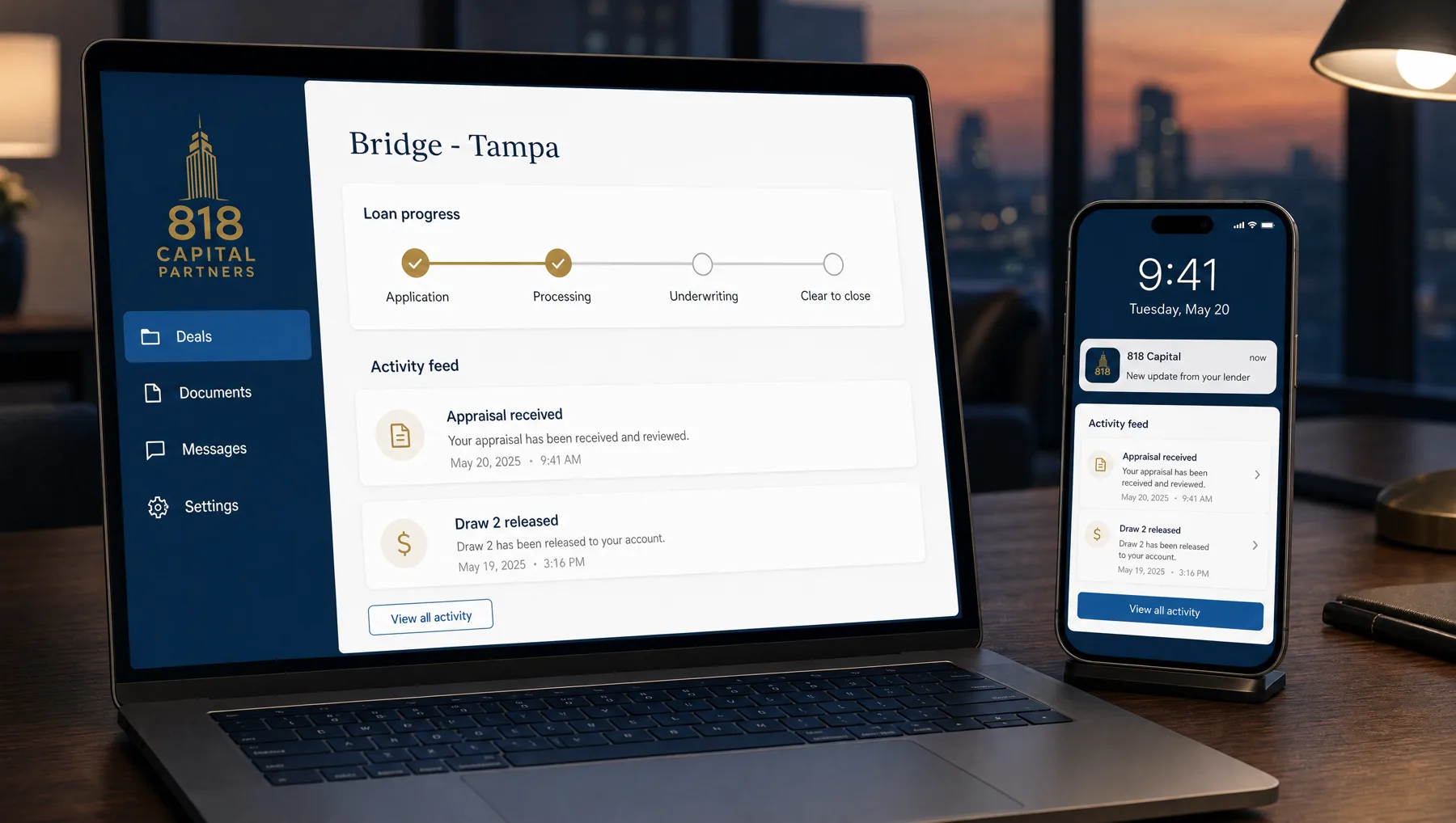
Every deal runs through the 818 Dealroom. Every update we share lands there the moment the file moves, so you are not calling anyone to ask where things stand.
Before you buy, during your hold, before you exit
A loan is a position in a market that keeps moving after your closing date. We watch rate, rent, and exit conditions with you before you buy, during your hold, and before you sell or refinance.
Taxes and insurance are not an afterthought in our DSCR analysis. They are half of the payment, so we price them in from the first quote, not at the closing table.
Ready to run the numbers.
Send us the scenario and we will tell you whether DSCR or conventional fits the deal in front of you.
818 Capital Partners · 110 Wall Street, New York, NY 10005 · NMLS #2832335 · Equal Housing Lender
Common questions.
What DSCR do programs typically want?
A common benchmark is 1.20x and above. Some programs allow lower ratios with pricing adjustments. The exact threshold depends on the program, the property, and the structure. Every quote is indicative until underwriting is complete.
Do DSCR loans require tax returns?
No. Qualification is based on the property’s rent against its full payment, including taxes, insurance, and association dues. That is the point of the product for self-employed investors and portfolio builders.
Can I close in an LLC?
Yes. Entity vesting is standard on business-purpose loans. Conventional loans generally require personal vesting.
Does short-term rental income count?
Some programs qualify on documented short-term rental performance, and some use market rent instead. Send us the scenario and we will tell you which applies.